
Same function, lower cost.
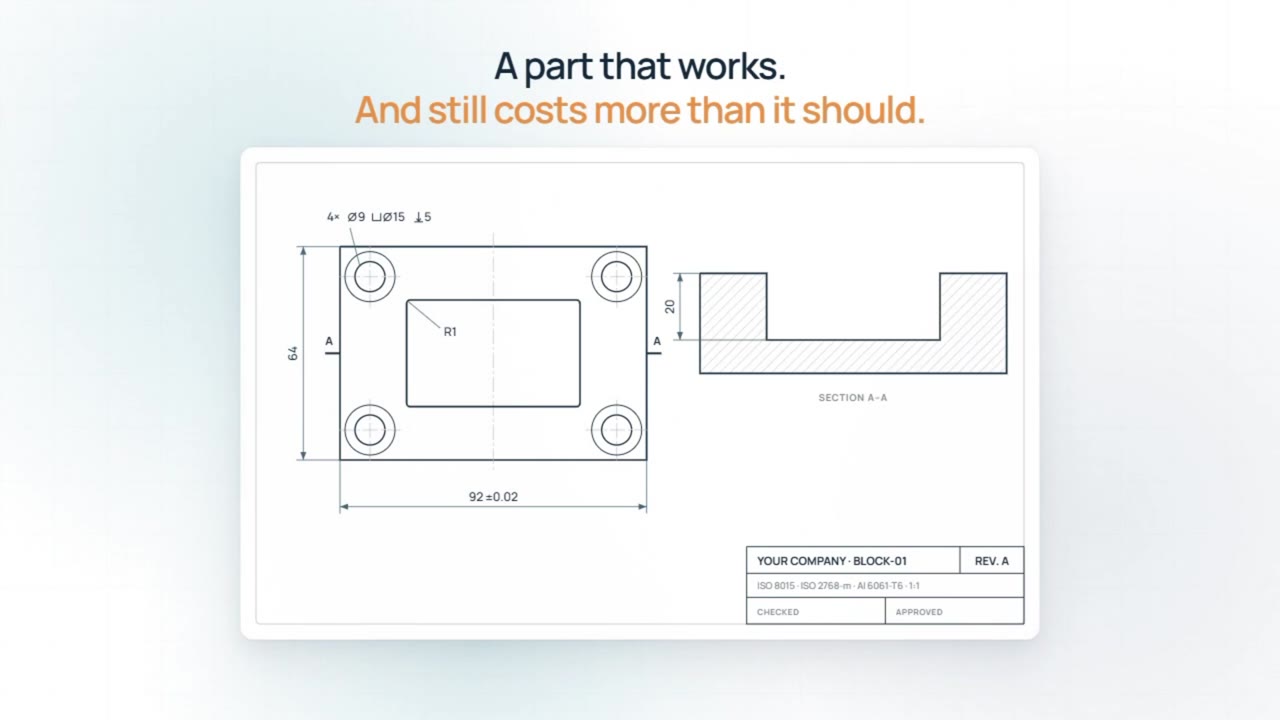
Much of a part's cost is decided by its geometry, long before production. We find what makes it expensive without adding function and deliver a solution your team can apply.
Same function, simpler tooling.
Two examples of how a small change in geometry replaces a special process with a standard one. Drag to compare.
Snap-fit hook without a side action
The underside of the hook is trapped in the mold and forces a side action or lifter. Opening a window in the wall right below the hook lets a core on the moving half form that face and release straight in the mold-opening direction.
- 15 to 30%is what side actions typically add to the cost of a mold
- 2 platesa simpler mold, with no moving components to maintain
- 3°minimum draft on the shut-off faces, so the mold does not wear
Pocket machined with a catalog end mill
An R1 inside corner 20 mm deep can only be cut with a long-neck ⌀2 end mill in many slow passes, or by EDM. With R7, a standard ⌀12 end mill machines the whole pocket, stiffer and faster.
- R ≥ ⅓of the depth: rule of thumb for the inside radius of pockets
- 1.7×the tool diameter in reach with ⌀12, inside the safe 2–3× range
- 0extra operations: no EDM and no special tooling in the corners
Illustrative examples based on published design guidelines for injection molding (Protolabs) and CNC machining. The gain of each change is estimated on your project before you decide.
Six levers we analyze on every part.
A part can work well and still carry unnecessary cost, complexity or dependence on a single supplier.
Simpler geometry
Radii, counterbores and holes that cost machine time and do not change the function.
Tolerances where function needs them
Opening what is not critical removes rework, inspection and scrap.
Geometry for the right process
Draft, wall thickness and tool access aligned with molding, machining or stamping.
Material and treatment
Sometimes the saving is in the material or the finish, not in the shape.
Simpler assembly (DFMA)
Fewer fasteners, fewer operations, and features that only assemble one way.
Easy to measure
Requirements your supplier can verify with the equipment it already has.
You get the solution, not just a list of problems.
- Prioritized opportunitiesranked by impact and effort
- Technical rationalefor every change and the risk involved
- Updated CAD modelwhen the solution is geometric.STP
- Material, process and tolerancesrecommendations where applicable
- A basis for your decisionyour engineering team validates and releases
Signs that a part could cost less.
The quote came in too high
The price does not match how complex the part ought to be.
Slow or difficult assembly
The line complains, the part fits more than one way or needs adjusting.
Only one supplier can make it
The geometry depends on a specific process or machine.
Recurring problems
Rejections, rework or deviations that come back with every lot.
What to send.
Beyond the basics, the current part cost and any quotes you already have help a lot with optimization.
- STEP assembly with the part and its mating parts.STP
- Material, manufacturing process and assembly sequence
- Part function and critical characteristics
- Estimated annual production volume
- Current cost, quotes received or target saving
- History of manufacturing or assembly issues
About optimization.
If the part already works, why change it?
Do you redesign the whole product?
Are your recommendations ready to send to production?
How is the price set?
Do you guarantee a percentage of savings?
Which part is costing too much?
Send the assembly and the basic information. We come back with scope, price and lead time.